
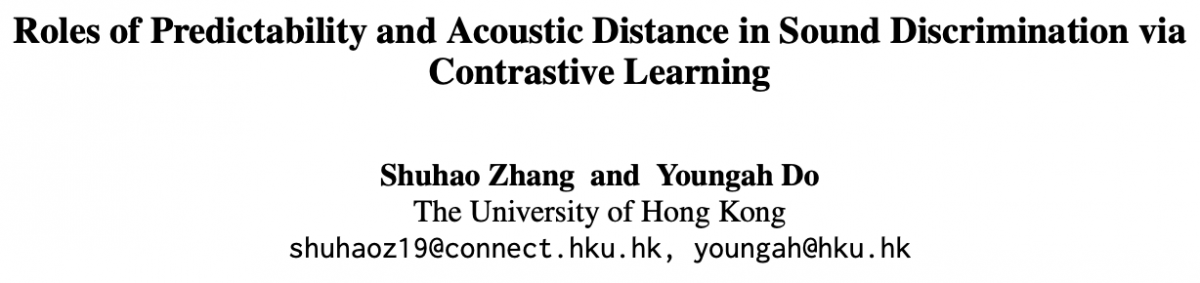
We are pleased to share a new publication by Shuhao and Youngah examining how predictability shapes sound discrimination in speech perception. Their paper, “Roles of predictability and acoustic distance in sound discrimination via contrastive learning,” is published in the proceedings of SCiL 2026 of the Association for Computational Linguistics.
The study investigates how predictability affects sound discrimination using a supervised contrastive learning framework, a machine learning approach that learns to distinguish between similar inputs by comparing them. The authors vary levels of predictability to examine whether its impact on discrimination is gradual or categorical, and they also explore how this effect interacts with acoustic distance (the degree of difference between sounds) and the presence of additional contrasts in a language.
The results show that only fully predictable sound patterns significantly reduce discrimination performance, suggesting a categorical effect rather than a gradual one. However, this reduction in sensitivity diminishes as the acoustic distance between sounds increases. In addition, the presence of other sound contrasts that share the same acoustic dimension improves discriminability, highlighting the importance of broader linguistic context in shaping speech perception.
Zhang, S., & Do, Y. (2026). Roles of predictability and acoustic distance in sound discrimination via contrastive learning. In Proceedings of the Society for Computation in Linguistics 2026 (pp.477–487). Association for Computational Linguistics. open_in_newDOI