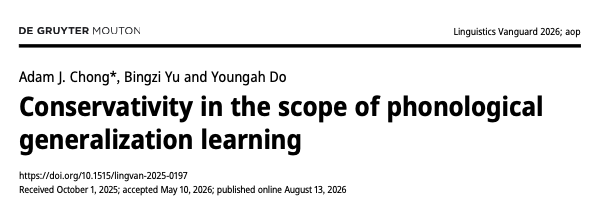
We are pleased to share a new publication by Adam, Bingzi, and Youngah in Linguistics Vanguard: “Conservativity in the Scope of Phonological Generalization Learning.”
The study investigates how people learn phonological patterns, or regularities in the sound systems of languages. In many languages, sound changes known as phonological alternations occur when words combine with affixes, often reflecting broader restrictions on which sound sequences are allowed in the language. Because of this relationship, many theories of phonology assume that knowledge of alternations and knowledge of phonotactics (sound-pattern restrictions within words) are closely linked.
These findings suggest that learners are conservative when extending newly learned phonological generalisations to unfamiliar morphological contexts. Together with previous research, the results indicate that the relationship between phonological alternations and phonotactic knowledge may not be as tightly connected in learning as some theoretical models have proposed.
Chong, A. J., Yu, B., & Do, Y. (2026). Conservativity in the scope of phonological generalization learning. Linguistics Vanguard. open_in_new DOI