Last week, Frank, Ming, and Youngah presented their talk titled “Learning tone sandhi from surface forms: A modeling approach” at HISPhonCog 2026 in Seoul, Korea.
Their presentation examined how learners acquire tone sandhi patterns using only surface tonal forms, without direct access to underlying representations. They used neural network models trained on artificial languages to explore challenges posed by various types of alternations—especially mergers and context-conditioned rules—and how factors like positional restrictions and diagnostic contexts influence generalization.
Key findings showed that while surface mergers can make category induction more difficult, sufficient non-neutralizing evidence enables models to maintain abstract distinctions. The results offer computational insights into the conditions that support or hinder the learning of tone sandhi patterns from naturalistic, incomplete input.
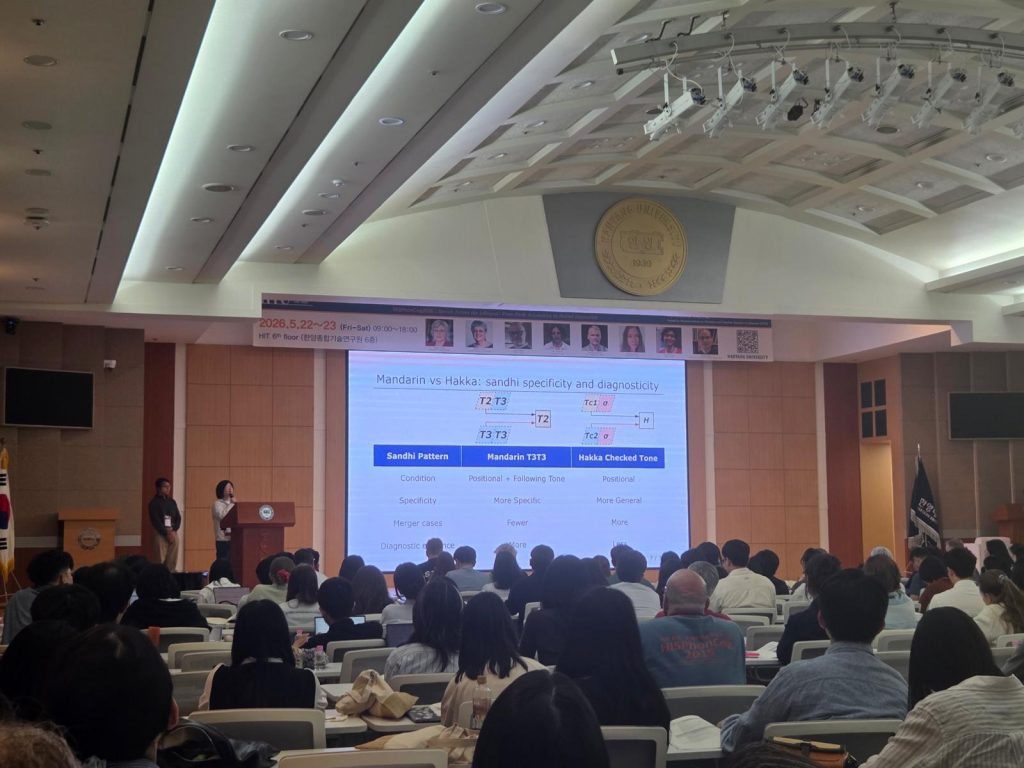
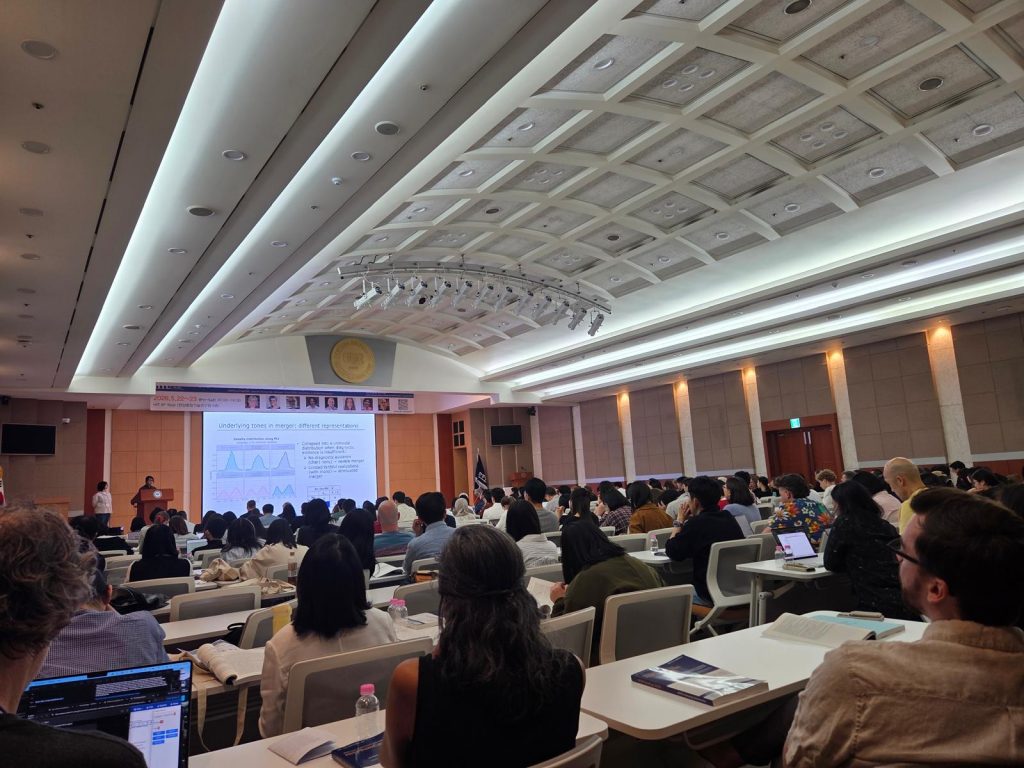

Tan, F. L., Liu, M., & Do, Y. (2026, May 22–23). Learning tone sandhi from surface forms: A modeling approach [Paper presentation]. Hanyang International Symposium on Phonetics and Cognitive Sciences of Language (HISPhonCog), Seoul, Korea.