

Events
Calendar of Events
|
Sunday
|
Monday
|
Tuesday
|
Wednesday
|
Thursday
|
Friday
|
Saturday
|
|---|---|---|---|---|---|---|
|
0 events,
|
1 event,
-
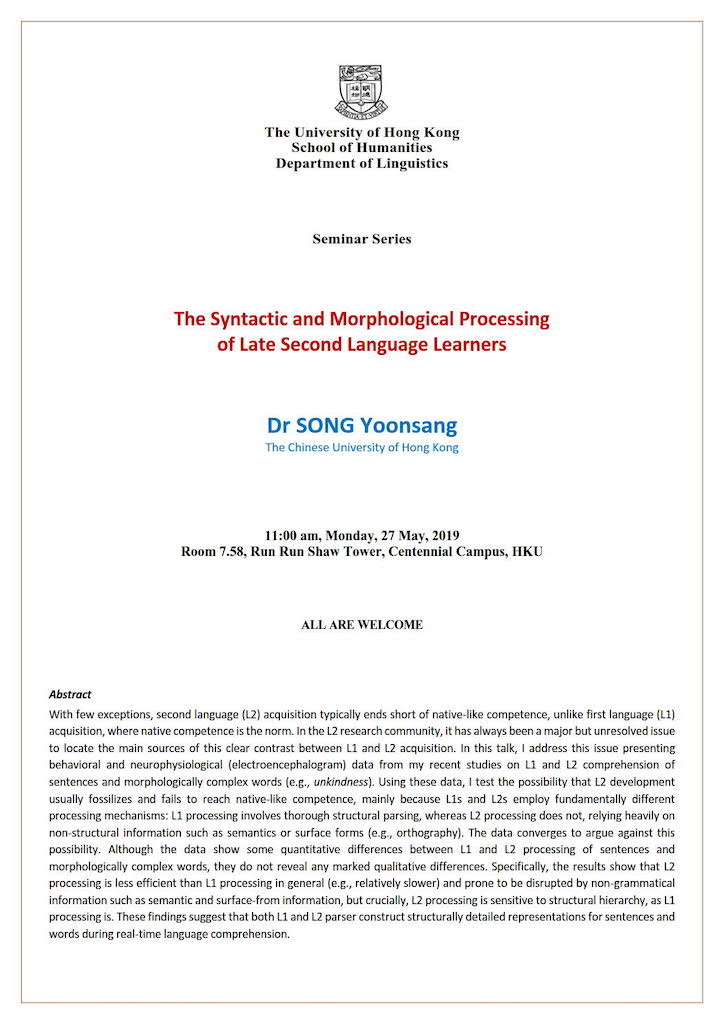
With few exceptions, second language (L2) acquisition typically ends short of native-like competence, unlike first language (L1) acquisition, where native competence is the norm. In the L2 research community, it has always been a major but unresolved issue to locate the main sources of this clear contrast between L1 and L2 acquisition. In this talk, I address this issue presenting behavioral and neurophysiological (electroencephalogram) data from my recent studies on L1 and L2 comprehension of sentences and morphologically complex words (e.g., unkindness). Using these data, I test the possibility that L2 development usually fossilizes and fails to reach native-like competence, mainly […] |
0 events,
|
1 event,
-
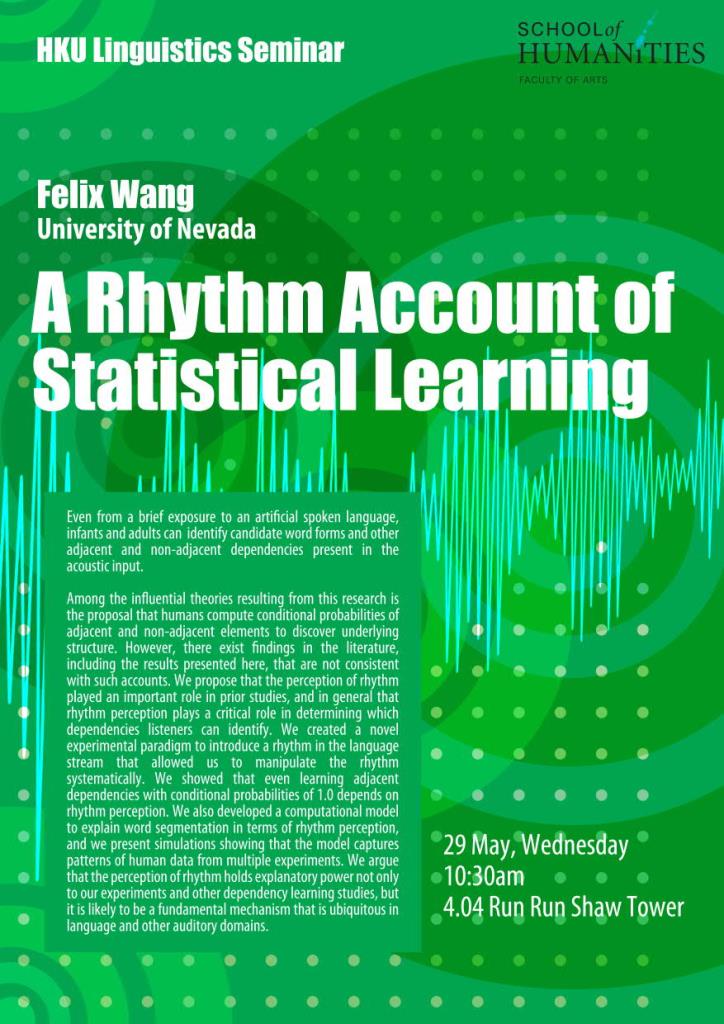
Even from a brief exposure to an artificial spoken language, infants and adults can identify candidate word forms and other adjacent and non-adjacent dependencies present in the acoustic input. Among the influential theories resulting from this research is the proposal that humans compute conditional probabilities of adjacent and non-adjacent elements to discover underlying structure. However, there exist findings in the literature, including the results presented here, that are not consistent with such accounts. We propose that the perception of rhythm played an important role in prior studies, and in general that rhythm perception plays a critical role in determining which dependencies […] |
1 event,
-
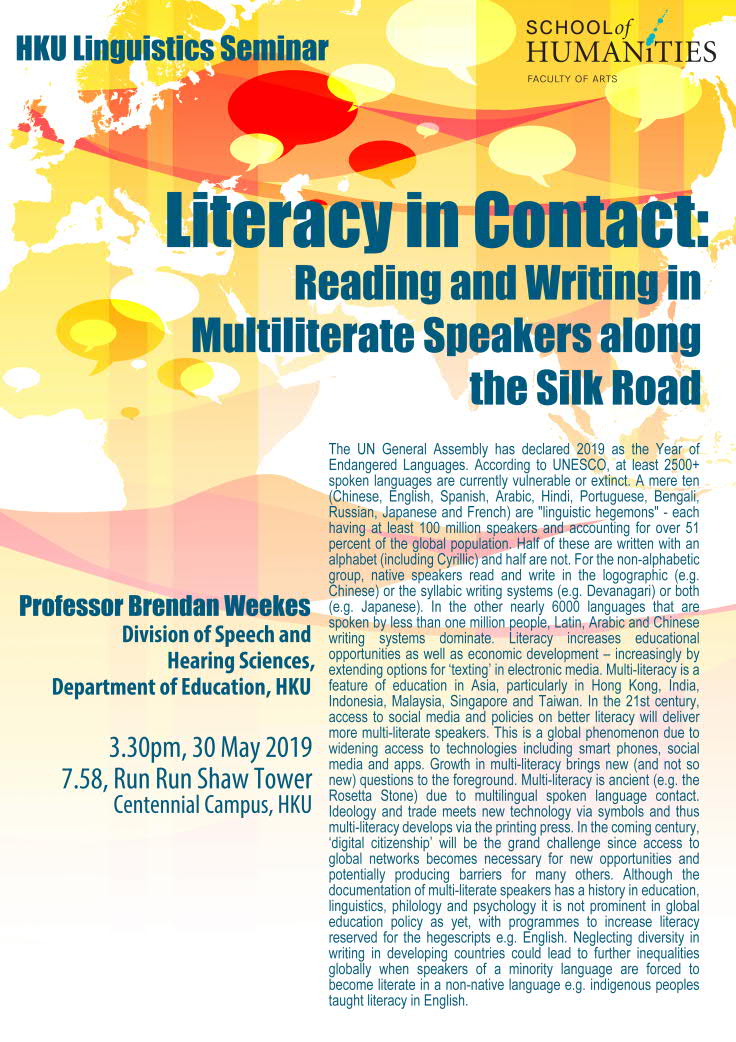
Abstract: The UN General Assembly has declared 2019 as the Year of Endangered Languages. According to UNESCO, at least 2500+ spoken languages are currently vulnerable or extinct. A mere ten (Chinese, English, Spanish, Arabic, Hindi, Portuguese, Bengali, Russian, Japanese and French) are "linguistic hegemons" - each having at least 100 million speakers and accounting for over 51 percent of the global population. Half of these are written with an alphabet (including Cyrillic) and half are not. For the non-alphabetic group, native speakers read and write in the logographic (e.g. Chinese) or the syllabic writing systems (e.g. Devanagari) or both (e.g. Japanese). […] |
0 events,
|
0 events,
|
|
0 events,
|
0 events,
|
0 events,
|
0 events,
|
0 events,
|
0 events,
|
0 events,
|
|
0 events,
|
0 events,
|
0 events,
|
0 events,
|
0 events,
|
0 events,
|
0 events,
|
|
0 events,
|
0 events,
|
0 events,
|
0 events,
|
0 events,
|
0 events,
|
0 events,
|
|
0 events,
|
0 events,
|
0 events,
|
0 events,
|
0 events,
|
0 events,
|
0 events,
|
|
0 events,
|
0 events,
|
0 events,
|
0 events,
|
0 events,
|
0 events,
|
0 events,
|